Resources
Insights
Australian Energy & Environmental Market Update - November 2025

Australian Energy & Environmental Market Update - November 2025

The latest edition of our monthly Australian Energy & Environmental Market Update is now available. Keep reading for energy and environmental price movements, policy updates and other news.

Updated
December 11, 2025
Published
December 11, 2025
Australian Energy & Environmental Market Update - November 2025

Australian Energy & Environmental Market Update November 2025

Highlights from this edition

Electricity markets

  • Average monthly spot prices remained subdued across the NEM, with VWAP easing slightly to $57.22 /MWh. Strong renewable generation continued to limit the reliance on gas-fired generation underpinning the downward price trend.  
  • Futures prices declined across most states, led by Cal26 contracts in QLD and NSW, with subdued spot market outcomes contributing to this trend.
  • Total BESS revenue has declined over the past three months, driven by subdued spot outcomes and a shift by some assets from market to SIPS revenues.

Environmental markets

  • LGCs weakened through November, with spot prices falling as low as $6.50/MWh before closing at $7.25/MWh amid persistent selling pressure.
  • VEECs surged sharply, rallying from the ~mid-$70/tCO2-e range to a peak of $86.00/tCO2-e before settling at $82.50/tCO2-e on tightening supply and strong buying activity.
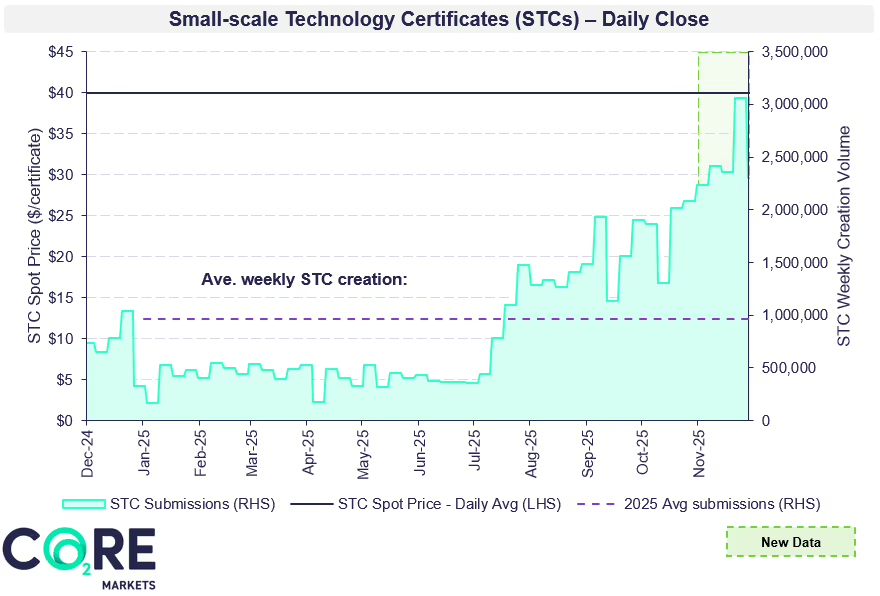
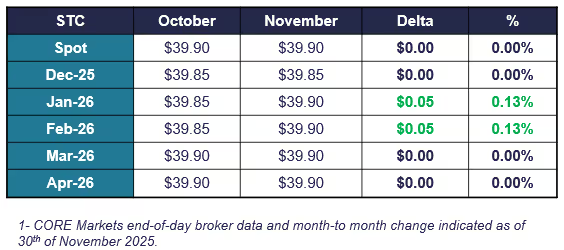
  • STCs remained steady at $39.90/MWh in the face of rapidly surging supply and limited market activity.
  • ESCs softened to $23.00/MWh as improving certificate registrations and steady selling pressure pushed prices lower.
  • PRCs stabilised near $2.85/certificate following the 95% reduction to the 2026-27 target and subsequent market repricing.

Market news

  • Key market developments this month include the announcement of three hours of free solar power, and the Kidston hydro project receiving AEMO registration as the first new Australian pumped hydro project in 40 years.

Australian electricity spot market

Monthly electricity spot market trends

  • Spot market outcomes in November remained relatively stable month-to-month, though an increase in intraday volatility, particularly in NSW, signalled the end of spring’s typically subdued pricing conditions.
  • The NEM volume-weighted average price (VWAP) declined to $57.22/MWh, the lowest monthly level recorded in 2025. The states driving the average monthly price decline most prominently were VIC (-39%) and SA (-36%). The downward movement itself was fundamentally underpinned by amplified renewable generation as compared to the prior month, with higher wind output in SA (+12%) and stronger solar generation in VIC (utility and rooftop +9%). Gas-fired generation across the NEM fell to 488 GWh, the lowest level this year, down 20% from last month.
  • NEM wide consumption remained steady at 1,766 GWh, sitting about 3% below the 2025 average and 1% lower than last month. Demand, however, was highly variable, particularly in SA, which experienced a Minimum System Load Level 1 (MSL1) market condition from the 11th to 12th.
  • The TAS market rebounded from October’s low, rising to $39.76/MWh, a 62% uplift, driven by declines in wind generation (-19%) and hydro generation (-7%) after strong output in October.

Daily electricity spot market trends

  • November saw mostly subdued pricing, the main market trends experienced were the material fluctuations in demand levels with a high frequency of negative intervals, and sharp intraday volatility.
  • The frequency of negative intervals remained elevated across the NEM (excluding TAS). This November was around 75% higher than the same month last year, with negative intervals occurring 31% of the time, driven mainly by SA and VIC.
  • Intraday volatility in NSW peaked significantly on the 25th and 26th. On the 25th, pricing surged to market cap at 12:20 pm and later nearly reached the market floor (-$1,000/MWh). Conditions on the 26th were more extreme, with NSW reaching the market cap in three successive intervals from 11:00 am to 11:10 am before falling to –$999.99 /MWh at 12:20 pm.
  • This pricing movement can be explained by several factors consistent with spring’s volatile market conditions. A surge in pricing early in the day was associated with unusually high temperatures driving up market demand, combined with a sudden drop in rooftop solar due to cloud cover, multiple binding transmission and network constraints, and significant curtailment of wind and solar generation during a storm.

Electricity futures market

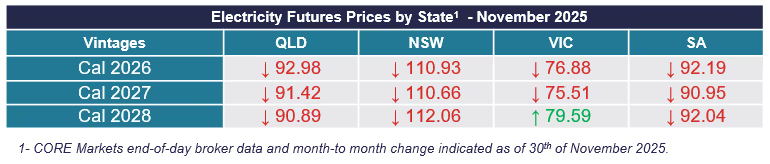
  • The futures market experienced a decline this month. By the end of the month all states had fallen, except for Cal28 in VIC. Cal26 vintages saw the most significant downward movement, with an average decline of $5.62/MWh, most notably in QLD (-$9.21/MWh) and NSW (-$6.20/MWh).
  • The fall in pricing was influenced by softer spot market outcomes in November with increased levels of RE penetration and substantial decline in gas-fired generation reliance.
  • The recent pattern of backwardation in the futures market has also shifted (except for QLD), indicating a change in market sentiment, with most states now showing higher pricing for Cal28 compared to Cal26.
Log in to the CORE Markets platform for more data, insights and commentary. Don’t have an account? Learn more

Renewables markets

NEM-wide variable renewable energy (VRE) penetration increased 0.46% from last month, reaching 42.24%. This growth was mainly driven by increased rooftop and utility solar generation overlayed with a lower underlying demand, typical for the spring season.

Monthly rotating focus: BESS asset performance

Each month we feature a different asset type - rotating between coverage of solar, wind and BESS projects. This month’s focus is BESS asset performance.

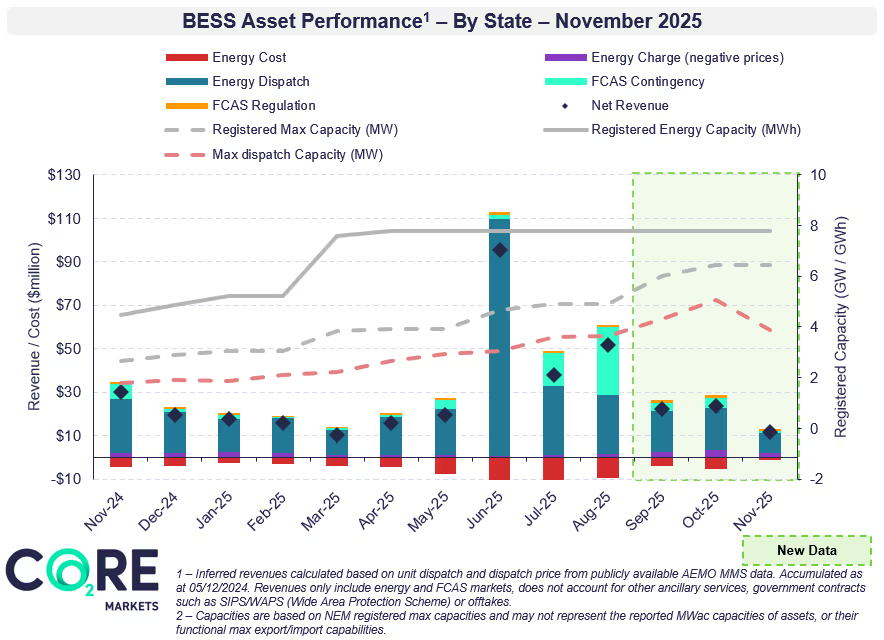
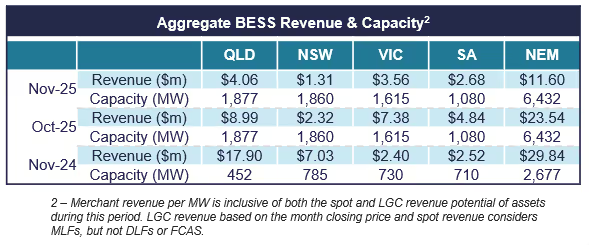
  • Over the past three months, subdued spot market pricing and a high frequency of negative-priced intervals have softened BESS revenue capture. November recorded the lowest monthly revenue capture for the year at $11.6 million. The decline was driven by weaker outcomes in both the wholesale energy and FCAS markets, with wholesale revenue falling 49% and FCAS revenue dropping 95% between August and November.
  • Dispatch capacity also declined in November, breaking the consistent growth trend seen in prior months. Capacity fell by 392MW despite registered maximum capacity for the month sitting at a high of 6,432MW.
  • The month-on-month decline reflects the 250MW from the Victorian Big Battery and 700MW from the Waratah Super Battery that is contracted under the System Integrity Protection Scheme (SIPS) for November to March, where market revenues are exchanged for network payments under these contracts.
  • Year-on-year revenue per MW decreased by ~85% across the NEM, driven by sharp declines in QLD and NSW, largely reflecting subdued spot market conditions.
Looking for more in-depth renewables asset analysis?
Learn more about our Wholesale Energy and Offtake Market Report, an important and recurring pulse check for renewable energy buyers and seller.

Environmental markets

Large-scale Generation Certificates (LGCs)

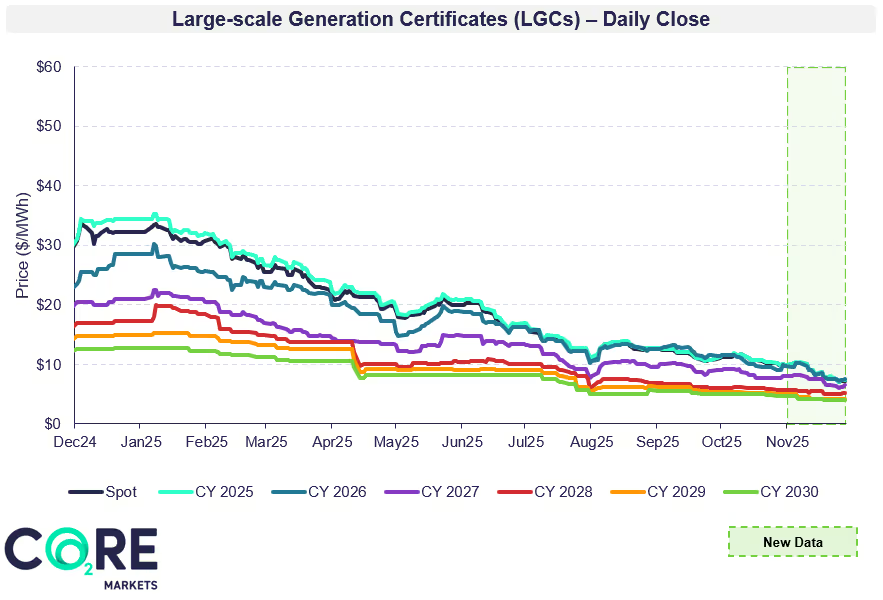
  • The LGC spot price trended lower through November as persistent merchant selling and weak demand weighed upon the forward curve.
  • Following early-month price stability, the market experienced a multi-session unwind, with spots sliding from the low-$9/certificate range to the high-$7s, before reaching a low of $6.50 on the 26th.
  • Cal26s and Cal27s bore the heaviest pressure, while longer-dated vintages softened more moderately.
  • Regulatory developments were limited, leaving fundamentals and positioning to dictate direction. A sharp late-month reversal briefly lifted prices, with spot rebounding as buyers emerged following a drought in liquidity.
  • Spot closed the month at $7.25 /MWh.
Log in to the CORE Markets platform for more data, insights and commentary. Don’t have an account? Learn more

Small-scale Technology Certificates (STCs)

  • STC markets remained largely inactive throughout November, with almost no on-market trading occurring.
  • The Clearing House moved from modest surplus to more than 2 million certificates by month-end, signalling ample supply but weak buy-side urgency.
  • Aside from isolated small parcel trades, there were no material market pricing signals or regulatory developments shaping the market through November.
  • Spot closed at $39.90/MWh.

Victorian Energy Efficiency Certificates (VEECs)

  • After consecutive months of gradual decline in the spot price, VEECs stabilised in early November before staging one of the more dramatic rallies seen in the scheme. The spot found support around ~$75/tCO2-e mark, then surged on the 18th from $76 /tCO2-e to $80 /tCO2-e as buyers overwhelmed thin offers, triggering a multi-session squeeze, hitting a high of $86 /tCO2-e on the 27th.
  • Momentum spilled into forwards and options, with tightening supply dynamics and stalled seller participation fuelling the sharp repricing.
  • Regulatory or structural changes were limited, but underlying scheme mechanics - particularly soft creation and growing forward uncertainty – continued to shape conditions
  • A late pullback showed moderated gains but did little to reverse the month’s net rise.
  • Spot closed the month at $82.50/certificate.

Energy Saving Certificates (ESCs)

  • ESCs steadily moved lower through November as selling pressure persisted against improving weekly certificate registrations. Spot values retreated from ~$25/MWh toward the mid-$23/MWhs, with several blocks of heavy turnover accelerating declines.
  • Forward activity remained orderly, while options trade increased mid-month, reflecting hedging interest as participants reassessed their downside exposure.
  • No major regulatory changes landed during the period; instead, softening reflected supply-demand dynamics normalising after months of constrained creation.
  • Temporary rebounds were brief, and by month-end the market had settled into a lower trading band, with participants awaiting clearer signals on supply momentum heading into the final weeks of the year.
  • Spot closed the month at $23/MWh.

Peak Reduction Certificates (PRCs)

  • November PRC activity was dominated by the NSW Government announcement of the 95% cut to the 2026–27 target. This was an unprecedented structural shift that reshaped market expectations. The announcement itself was driven by concerns over high residential battery activity and misalignment with the federal rebate, triggered immediate turmoil: record turnover, deep uncertainty, and an erosion in long-term confidence.
  • Following the immediate shock of the announcement, the curve stabilised into a flat outlook around $2.65–2.75-mark, before strengthening mid-month as scarcity concerns reasserted themselves.
  • Forwards lifted above $3.00 late in the month, driven by tightening supply and persistent doubts about achieving the 2025–26 target. Consultation on new activities is now the key catalyst ahead.
  • Spot closed the month at $2.85/certificate.

Looking for ACCU coverage? Read our ACCU Market Monthly Report here.
Log in to the CORE Markets platform for more market data, insights and commentary. Don’t have an account? Learn more

Market news

Three hours of free solar power plan

  • The government announced on 4th November a proposal to give households three hours of free power each day by expanding access to solar generation. The plan builds on declining renewable and storage costs and aims to encourage more daytime electricity use when solar output is strongest.
  • The announcement has prompted a wide range of views. Some see it as a way to reduce household bills, improve utilisation of abundant daytime solar and ease pressure on evening peak demand.
  • Others highlight challenges, including whether retailers can structure tariffs to deliver genuinely free power, the need for smarter appliances and automation to take advantage of the free window, and the risk that very low daytime prices could weaken investment signals for new renewable and storage projects.
  • There are also concerns about network constraints in regions with high rooftop solar and whether the scheme may require additional infrastructure or incentives to manage shifting load at scale.

Kidston becomes first new pumped hydro in 40 years

  • On 18th November, the Kidston pumped hydro project in QLD was registered with AEMO, becoming the first new pumped hydro facility to join Australia’s main grid in 40 years.
  • The project’s first 125 MW reversible unit has begun commissioning, with a second unit planned to bring total capacity to 250 MW and up to eight hours of storage, providing long  duration support for North QLD’s grid.
  • Owned by Genex Power and fully backed by JPower, the project is under a 30 -year dispatch agreement with Energy Australia.
  • Kidston’s registration marks a major milestone for long  duration  storage in Australia as the grid adapts to more variable renewable generation.

What this month’s developments mean for market participants

Australian energy market

This month, the energy market experienced subdued pricing, and these conditions highlight risks for sell-side spot market exposed entities. Many asset owners may rely on PPAs, swaps, firm blocks, and other offtake mechanisms for revenue certainty. The lower merchant revenues for renewable energy projects could prompt further LGC sell-offs as cash flow is managed during spring. These contract mechanisms and in-depth market insights are outlined in CORE Markets’ offtake market report.

Subdued pricing in the spot market too underscored the current opportunity for buyers and the importance of implementing well-timed hedging strategies as summer volatility builds.

These dynamics are explored in CORE Markets’ Wholesale Energy and Offtake Market Report, which outlines current contracting structures, price signals and risk management approaches across the renewable energy market.

The CORE Markets team partners with renewable energy developers and corporate buyers to manage market risks.  Get in touch to explore how we can support your energy market approach.

Australian environmental markets

The LGC market continued its downward trend in spot and forward prices throughout November, reflecting ongoing weakness in the value of LGCs generated from both existing and upcoming renewable assets through to 2030.

The STC market remained steady, supported by record-high certificate creations driven by the Federal Government’s Battery Rebate Scheme introduced back in July 2025.

November PRC activity this month was dominated by the NSW Government’s announcement of the 95% cut to the 2026–27 target.

Staying ahead of these market and regulatory shifts will be key to optimising procurement and managing compliance costs effectively.

The CORE Markets team supports demand and supply side market participants in navigating these markets – across strategy, procurement and trading execution. Get in touch to learn how we can support your goals.

Do you need help navigating energy and environmental markets?

The events outlined in this month's update highlight the evolving nature of energy and environemental markets and the complexity of the net zero transition.

To discuss your unique requirements, get in touch with our team today to see how we can help.

Access this full article and more

Log in or register a free CORE Markets account to get closer to power, environmental and carbon markets with insights and updates from our experts.

Tags

Share this article

Receive more articles like this

You Might Also Like
Australian Energy & Environmental Market Update - November 2025
Market Update

Australian Energy & Environmental Market Update - November 2025

The latest edition of our monthly Australian Energy & Environmental Market Update is now available. Keep reading for energy and environmental price movements, policy updates and other news.

Global Environmental Markets Update - November 2025
Market Update

Global Environmental Markets Update - November 2025

This update is published monthly and provides analysis of key developments in select compliance and voluntary carbon, and Sustainable Aviation Fuel markets.

ACCU Market Monthly Report - November 2025
Market Update

ACCU Market Monthly Report - November 2025

This report provides an overview of the month’s Australian Carbon Credit Unit (ACCU) market activity along with key developments and milestones.